

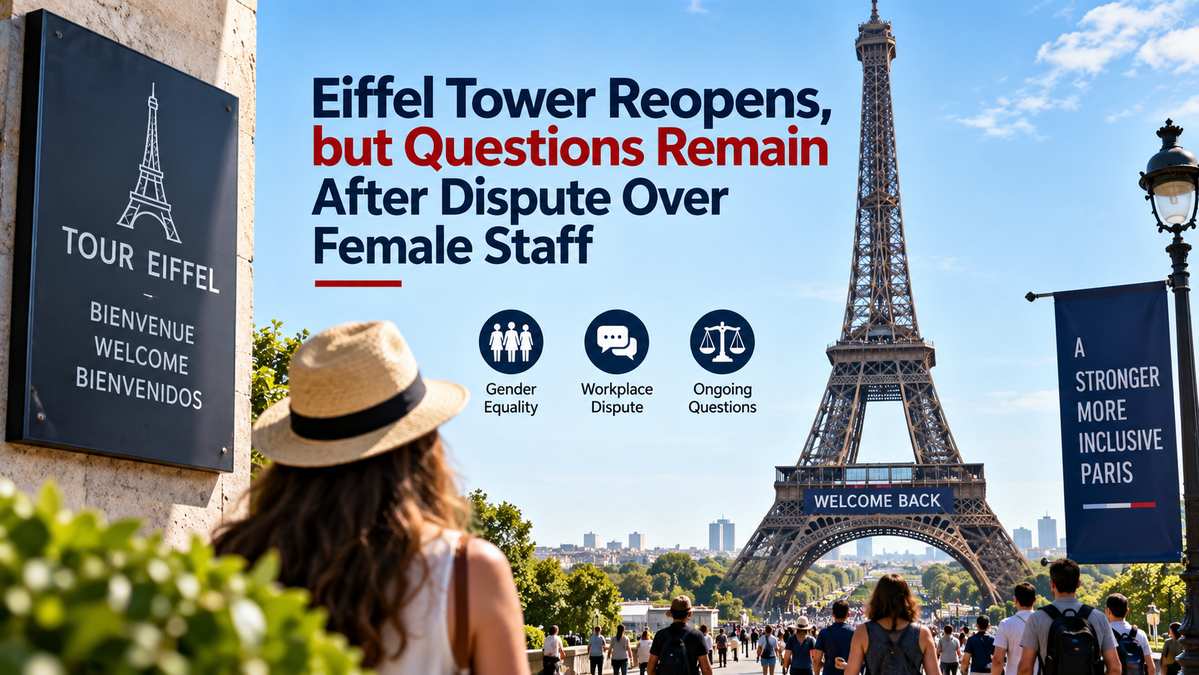
The Eiffel Tower is welcoming visitors again, but a one-day closure has left behind a much bigger debate about workplace equality, religious accommodation and the management of one of France’s most recognizable landmarks.
The Paris monument reopened after employees walked out in protest over the treatment of female colleagues during a private visit by a Hindu religious delegation. The organization involved, the Bochasanwasi Akshar Purushottam Swaminarayan Sanstha, or BAPS, later apologized for the “pain or inconvenience” caused by the episode.
The immediate disruption was short-lived. The questions surrounding how the incident happened are likely to last much longer.
What Happened During the Private Visit?
The controversy began with a private BAPS delegation visiting the Eiffel Tower on September 5.
According to employee representatives and subsequent reporting, female staff members were asked to move away from certain positions while the delegation was passing through, with male employees taking their places.
The Eiffel Tower’s operating company, Société d’Exploitation de la Tour Eiffel, or SETE, later acknowledged that the delegation had requested arrangements designed to limit interactions with women. The company said those conditions should not have been accepted.
That decision triggered anger among employees.
For the workers involved, the issue was not simply about rearranging staff for a private event. It was about whether female employees could be treated differently because of the preferences associated with a visiting religious group.
A Private Event Became a Workplace Dispute
The Eiffel Tower regularly hosts private events and special visits, meaning management has to balance visitor arrangements with normal operations.
But the BAPS visit created a different challenge.
BAPS religious leaders, known as sadhus, follow strict religious rules that include avoiding physical contact and interaction with women. Those rules apply to the religious leaders rather than to every member of the broader BAPS community.
The problem arose when those practices intersected with the workplace arrangements at a public landmark.
Instead of remaining a matter of private religious observance, the arrangement affected employees who were carrying out their normal jobs.
That is what transformed the visit into a labor dispute.
Workers Responded With a Strike
The dispute escalated over the weekend.
On September 7, Eiffel Tower employees went on strike, preventing the monument from opening normally. Visitors were informed that the opening had been delayed because of operational reasons.
The action lasted one day, and the tower reopened on September 8 after discussions and an apology from BAPS.
The closure demonstrated how quickly an operational decision made for a private event can affect a landmark visited by thousands of people.
For the employees, however, the action was also about establishing a clear boundary for future events.
BAPS Apologizes
BAPS issued an apology following the controversy.
The organization said it was sorry for any pain or inconvenience caused and maintained that, to its knowledge, nobody had been prevented from accessing the Eiffel Tower.
It also said the visit had been arranged with the Eiffel Tower team because of the size of its delegation and the desire to avoid disrupting other visitors.
The statement helped the tower reopen, but it did not answer every question about who requested the staffing arrangement or who authorized it.
That question has become central to the subsequent investigation.
French Authorities Want to Know Who Approved the Arrangement
Paris authorities moved to investigate the circumstances surrounding the incident.
Paris officials said the treatment of the female employees required examination, while the tower’s management came under scrutiny over how the arrangements for the private visit had been handled.
That shifts the story beyond the actions of the visiting delegation.
The key institutional question is whether management should have rejected the request immediately—or whether employees were moved without sufficiently considering the implications for workplace equality.
Why the Eiffel Tower Became the Focus
The location itself has added weight to the controversy.
The Eiffel Tower is not an ordinary private venue. It is one of France’s most recognizable public landmarks and a symbol that attracts visitors from around the world.
That makes the incident a useful test of how cultural and religious diversity is accommodated inside public-facing institutions.
Religious groups can have their own practices and rules. Workplaces, meanwhile, operate under French employment and equality standards.
When those two systems meet, the institution hosting the event has to determine where accommodation ends and unequal treatment of employees begins.
That is precisely the issue now under examination.
The Incident Does Not Represent Hinduism as a Whole
It is also important not to generalize the dispute to Hinduism as a religion.
BAPS is a specific Hindu organization with its own religious traditions and rules. The reported restrictions concerning interaction with women relate particularly to its sadhus and should not be presented as a practice followed by Hindus generally.
That distinction matters because the Eiffel Tower controversy concerns a specific delegation and a specific workplace decision.
The incident should therefore be understood through the actions and policies involved rather than used to characterize an entire faith community.
A Larger Question About Religious Accommodation
The episode has reopened a familiar question in multicultural societies: how far should public institutions go to accommodate religious practices?
In many circumstances, reasonable accommodation allows people to observe religious requirements while continuing to participate in public life.
But accommodation becomes more complicated when it affects another person’s employment.
Moving an employee because of gender is fundamentally different from providing a private prayer area, adjusting food options or accommodating a religious holiday.
The Eiffel Tower dispute illustrates that difference in a very visible setting.
Management Is Now Under Greater Scrutiny
The controversy has also exposed tensions inside the organization that operates the monument.
Subsequent reporting has examined the management of SETE and previous disputes involving working conditions and relations between employees and management.
That means the BAPS episode is being viewed not only as an isolated incident but also in the context of broader questions about workplace governance.
For management, the challenge is now twofold: rebuild trust with employees while ensuring that future private events are handled under clear and consistent rules.
The Apology Was Only the First Step
BAPS’s apology helped bring the immediate dispute to an end, but an apology does not necessarily resolve the institutional questions.
Employees still want assurances that similar arrangements will not happen again.
Management must determine how the decision was made, who approved it and what safeguards should be introduced for future private visits.
Those steps could prove more important than the brief closure itself.
The Eiffel Tower Is Open Again—But the Debate Continues
Visitors have returned to the Eiffel Tower, and normal operations have resumed.
Yet the episode has left a broader lesson for major public venues.
Private religious or cultural events can require special arrangements, but those arrangements still have to fit within workplace rules and principles of equal treatment.
The Eiffel Tower controversy began with a request connected to a private religious visit. It ended with a staff strike, a public apology and an official investigation.
The monument may have reopened after just one day, but the bigger issue is how institutions can respect religious diversity without compromising the rights of the people who work inside them.
That question extends well beyond Paris.
For the Eiffel Tower’s management, the next test will not be reopening the doors. It will be demonstrating that the rules governing those doors—and the people working behind them—are clear, consistent and applied equally to everyone.