

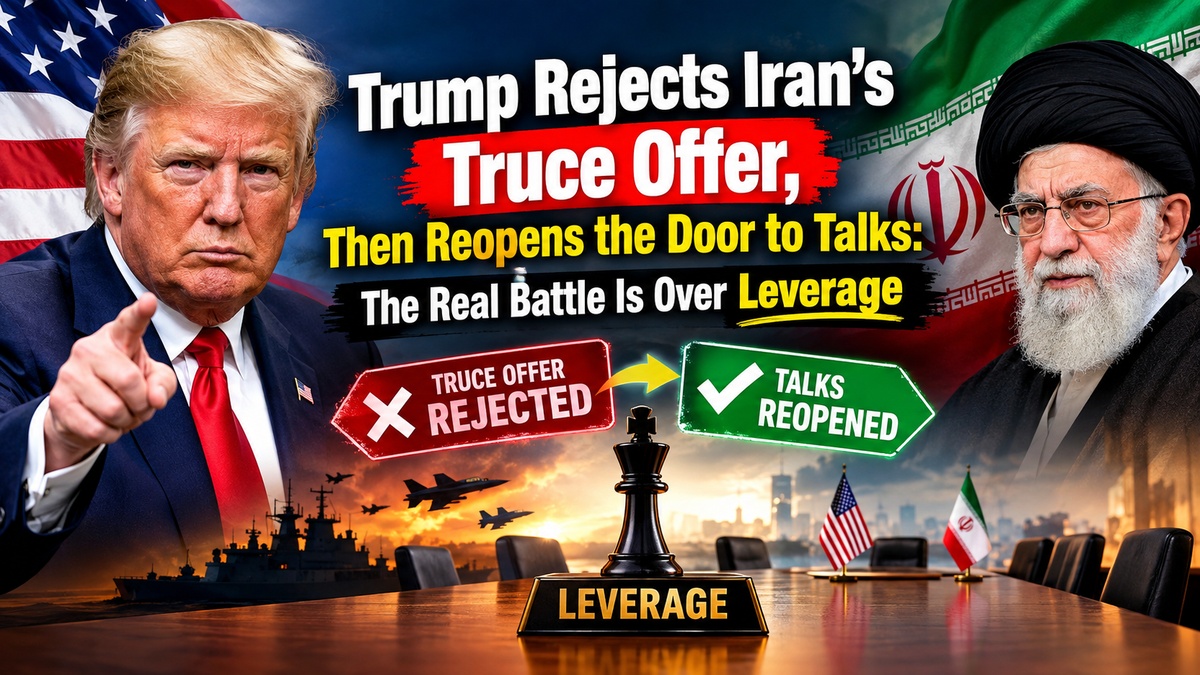
The United States and Iran appear to be moving toward another round of diplomacy, but neither side is giving the impression that it is ready to compromise first.
President Donald Trump rejected an Iranian proposal aimed at reopening the Strait of Hormuz and restarting nuclear negotiations, saying Tehran had “overplayed their hand.” Yet only a day later, Trump said he expected more talks with Iran during the coming week.
That apparent contradiction may actually explain where the conflict stands.
Washington and Tehran are not walking away from diplomacy. Instead, they are trying to negotiate while maintaining as much leverage as possible.
The next round of indirect discussions, potentially beginning as early as Monday, is expected to involve regional mediators, particularly Qatar.
Trump Says Iran Wants a Deal — But Not His Deal
Trump’s message was blunt.
“They want to make a deal,” he told Axios, but added that the proposal on the table was not acceptable to him. He said it was something Washington might have accepted a year earlier and argued that Iran had “overplayed their hand.”
But his decision to reject Tehran’s proposal did not close the diplomatic channel.
Instead, Trump said he expected negotiations to continue this week.
That distinction is important. A rejected proposal is not necessarily a rejected negotiation.
The two sides can reject each other’s terms while continuing to explore whether a different arrangement is possible.
Hormuz Is at the Center of the Dispute
The Strait of Hormuz has become the most important bargaining chip in the conflict.
Before the war, roughly one-fifth of global oil and gas supplies moved through the waterway. Its disruption has therefore affected not only Iran and the United States but also energy markets, Asian importers and Gulf producers.
Iran’s proposal reportedly involved reopening the strait while restarting nuclear negotiations.
In return, Tehran wanted Washington to ease or lift its blockade and provide other economic concessions, including relief connected to sanctions and potentially access to frozen Iranian assets.
The Iranian position is essentially that Hormuz can become part of the solution.
Washington sees the same waterway differently: reopening it is something Iran must deliver as part of a broader settlement.
That difference in sequencing is one of the biggest obstacles.
Why Neither Side Wants to Blink First
Diplomatic negotiations often come down to timing.
If one side makes a major concession before the other, it risks losing leverage.
That is exactly the problem facing Washington and Tehran.
Iran wants relief from economic and military pressure. The United States wants secure navigation through Hormuz and broader concessions from Tehran, particularly concerning Iran’s nuclear program.
Reuters reported that negotiators have been exploring a phased arrangement in which Hormuz could reopen while Washington reduces its blockade, but the durability of such an agreement remains a major concern.
The question is not simply whether a deal can be written.
It is whether either side believes the other will honor it.
Secret Diplomacy Has Already Restarted
Despite the public confrontation, diplomatic contacts have continued.
During the UN General Assembly in New York, U.S. envoys Steve Witkoff and Jared Kushner held indirect discussions with Iranian Foreign Minister Abbas Araghchi through mediators.
Qatar has been playing an important role in passing messages between Washington and Tehran.
The possible resumption of talks this week would therefore not represent a completely new diplomatic effort. It would be another stage in contacts that have already been taking place behind the scenes.
That makes the next discussions particularly important.
The negotiators already know many of the other side’s demands.
The challenge is finding a sequence of concessions that both governments can accept.
Iran Says Diplomacy Is Still Possible
Tehran has also kept the diplomatic door open.
Iranian Foreign Minister Abbas Araghchi said Iran remains prepared for diplomacy while warning that Tehran is also prepared to continue fighting if necessary.
He said Iran’s conditions for reopening the Strait of Hormuz remain in place.
That position highlights the central contradiction in the current situation: Iran is talking about diplomacy while preparing for continued confrontation, while Washington is discussing negotiations while keeping military action on the table.
Neither side appears willing to abandon its security options simply because talks are taking place.
Trump Has Not Taken Military Action Off the Table
The diplomatic activity should therefore not be interpreted as proof that the war is ending.
When asked whether he was considering renewed strikes against Iran, Trump said, “I am always thinking about it.”
That statement keeps military escalation as a possibility even while negotiators prepare for another round of talks.
It creates a difficult environment for diplomacy.
Negotiators have to discuss concessions while knowing that military action could resume if talks collapse.
For Washington, that pressure can be used as leverage.
For Tehran, it can reinforce the argument that any agreement must contain meaningful guarantees.
The Oil Market Is Watching Every Move
The diplomatic dispute is also an energy story.
Trump said more than 20 million barrels of oil had moved through the Strait of Hormuz over the weekend, which he described as the largest volume since the war began. A U.S. defense official separately told Axios that about 22 million barrels were exported through the strait on Friday night.
That suggests that traffic through the waterway has not been completely frozen.
At the same time, the wider conflict has already disrupted energy flows and raised concerns about supply security.
Any credible agreement that guarantees sustained navigation through Hormuz could therefore have consequences well beyond Washington and Tehran.
It could affect oil prices, shipping costs, inflation and the economies of countries that depend heavily on Gulf energy.
Qatar’s Role Is Becoming More Important
Qatar has emerged as one of the key intermediaries in the latest diplomatic effort.
The country has experience communicating with both Washington and Tehran and has repeatedly played a mediation role in Middle Eastern conflicts.
If another round of indirect U.S.-Iran talks takes place, Qatari mediators could provide the channel through which proposals and counterproposals move without requiring Trump and Iranian leaders to meet directly.
That may be essential because direct political engagement remains highly sensitive for both governments.
The Hardest Issue May Be What Comes After Hormuz
Reopening the Strait of Hormuz could provide an immediate economic benefit, but it would not solve every disagreement between Washington and Tehran.
The nuclear issue remains.
So do sanctions, frozen assets, military restrictions and the future of Iran’s relationship with regional armed groups.
That means even a temporary agreement over the strait could leave the larger conflict unresolved.
Reuters has reported that negotiators are considering a phased approach precisely because attempting to solve every issue simultaneously could make agreement more difficult.
A smaller first step could create space for larger negotiations.
But previous understandings have broken down, making both sides wary of temporary arrangements that could collapse again.
Why the Next Talks Matter
The most important development is therefore not Trump’s rejection of Iran’s latest proposal.
It is what happened immediately afterward.
The proposal was rejected, but the negotiating channel remained open.
That tells us something about the current state of the conflict.
Neither Washington nor Tehran appears ready to accept the other’s preferred terms, but both have reasons to keep diplomacy alive.
Iran faces the economic consequences of prolonged confrontation and pressure on its ability to trade.
The United States faces the cost of continuing a major military operation while trying to restore stability to a strategically vital shipping route.
The Gulf states have their own interest in preventing further escalation.
And global energy markets have an enormous stake in whether Hormuz remains reliably open.
The Bigger Story: A Negotiation About Who Gives Up Leverage First
The phrase “they overplayed their hand” captures Trump’s assessment of Iran’s proposal.
But the broader diplomatic picture is more complicated.
Iran believes reopening Hormuz can be exchanged for relief from U.S. pressure.
Washington wants the strait reopened while demanding broader concessions from Tehran.
Both sides are therefore trying to turn the same crisis into bargaining power.
That is why another round of talks does not necessarily mean peace is close.
It means the two sides have decided that diplomacy is still worth testing.
The real challenge will be whether they can move from trading demands to trading verifiable concessions.
For now, the Strait of Hormuz remains at the center of that equation. If the waterway can become the first step toward a broader arrangement, the latest diplomatic opening could gain momentum. If neither side is willing to surrender leverage first, the talks could become another temporary pause before the conflict resumes.