

The idea of a war fought beyond Earth’s atmosphere once sounded like science fiction.
That is no longer the case.
Satellites have become essential to modern militaries, supporting communications, navigation, surveillance, intelligence and precision operations. As countries increasingly depend on those systems, the ability to disrupt an opponent’s space infrastructure is becoming an important part of military planning.
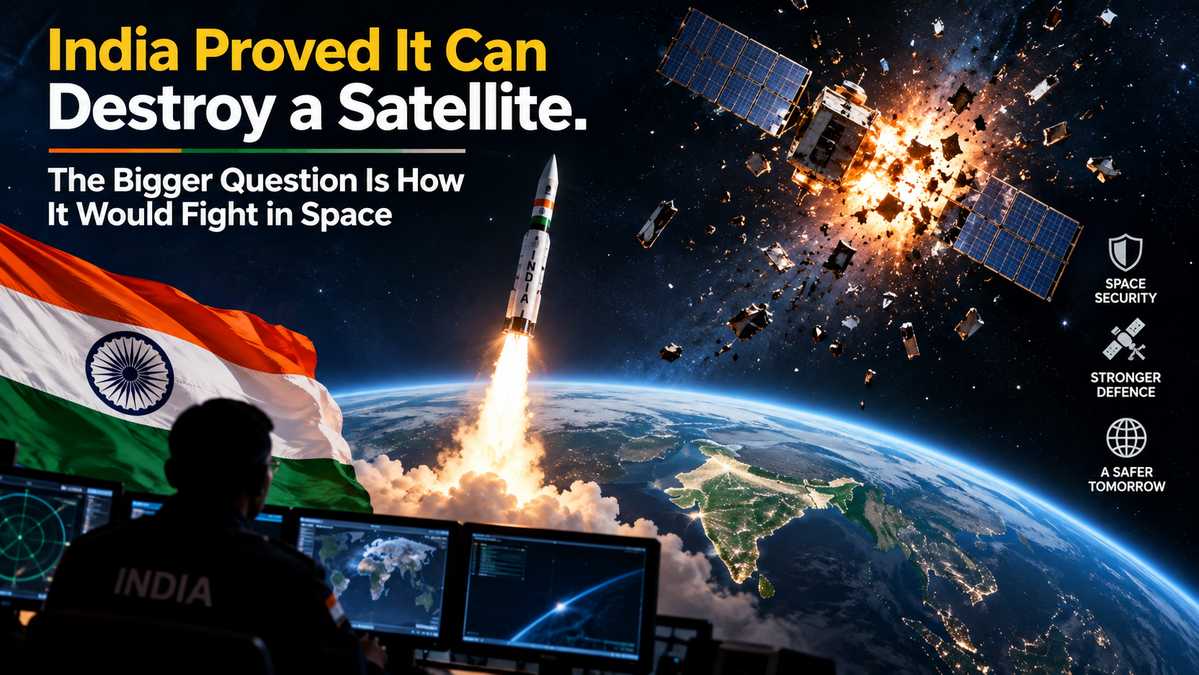
India has already demonstrated that it can destroy a satellite.
But the more important question today is much broader: Does India have the wider range of capabilities needed to protect its satellites and operate effectively if a conflict extends into space?
That question has gained fresh importance after the United States publicly acknowledged that it has deployed what officials describe as space-control weapons in orbit. Washington has not disclosed exactly what those systems are, but the announcement has added to concerns about a growing competition involving the United States, China and Russia.
Mission Shakti Put India on the ASAT Map
India demonstrated its anti-satellite capability in March 2019 through Mission Shakti.
The Defence Research and Development Organisation used a modified ballistic-missile interceptor to strike the Microsat-R satellite in low Earth orbit.
The weapon used a “hit-to-kill” approach, meaning the interceptor destroyed its target through the force of a high-speed collision rather than by detonating an explosive warhead.
The successful test made India the fourth country, after the United States, Russia and China, to publicly demonstrate the ability to destroy a satellite in orbit.
It was a significant technological demonstration.
But one successful test should not be confused with an entire space-warfare architecture.
Shooting Down a Satellite Is Only One Part of Space Warfare
An anti-satellite missile is perhaps the most dramatic space weapon because its effect is easy to understand: find a satellite and destroy it.
Actual conflict in space could be far more complicated.
A country could attempt to interfere with satellite communications, jam signals, disrupt navigation, attack ground infrastructure or use cyber operations against space-related networks.
Other possibilities include spacecraft capable of maneuvering close to another satellite, surveillance systems designed to monitor objects in orbit and technologies intended to interfere with sensors or communications.
That means space warfare is not simply about firing missiles upward.
It is about controlling, protecting and disrupting an entire network of space-dependent capabilities.
China’s Space Activities Show Why the Picture Is Changing
China has demonstrated technologies that go beyond traditional missile-based interception.
In 2022, the Chinese Shijian-21 satellite demonstrated the ability to grapple with another spacecraft and change its orbit. Such technology can have peaceful applications, including removing debris, but similar capabilities could potentially be relevant to military operations involving other spacecraft.
This illustrates one of the unusual characteristics of space technology.
The same capability can sometimes have both civilian and military uses.
A spacecraft designed to repair or move another satellite could theoretically have applications in a conflict.
That makes judging a country’s true offensive capabilities particularly difficult from publicly available information.
The United States Has Now Made a Remarkable Admission
The debate has become more urgent following recent statements from senior US officials.
US Air Force Secretary Troy Meink said the United States possesses “on-orbit space control weapons” capable of defending US forces against hostile actions. US Space Force chief Douglas Schiess subsequently said personnel operate on-orbit weapons. Neither official publicly described the specific systems involved.
The significance lies partly in the wording.
For years, countries have publicly discussed counter-space capabilities without necessarily describing particular systems as weapons stationed in orbit.
The latest US statements make the existence of such capabilities much more explicit.
China and Russia have criticized the development, warning about the possibility of a wider arms race in outer space.
So Where Does India Fit?
India sits in a different position.
Mission Shakti established that India possesses the technical ability to conduct a direct-ascent kinetic ASAT interception.
India has also been developing systems for monitoring objects in space. DRDO’s publicly listed space-situational-awareness work includes technologies for detecting and tracking low-Earth-orbit satellites using optical sensors, radar and lidar.
Those capabilities matter because a country cannot protect its satellites if it cannot identify what is happening around them.
However, publicly available information does not establish that India has deployed an orbital weapons system comparable to the recently acknowledged US capabilities.
Nor does the 2019 test by itself demonstrate that India possesses the full spectrum of counter-space capabilities attributed to the major space powers.
That distinction is important.
Protecting Satellites May Be More Important Than Destroying Them
India’s dependence on space infrastructure is growing.
Satellites support communications, navigation, weather services, surveillance and other activities with civilian and military applications.
The country’s NavIC navigation system is one example of how space infrastructure has become part of national capability.
If a conflict were ever to threaten those systems, simply possessing an ASAT missile would not guarantee continued access to space services.
A more comprehensive defense could involve redundancy, additional satellites, stronger communications links, cyber protection, space-domain awareness and the ability to replace damaged assets.
In other words, survivability may matter as much as firepower.
Space Warfare Could Begin Without a Missile Launch
One of the biggest misconceptions about a future space conflict is that it would necessarily begin with satellites exploding.
It might not.
Interference with communications could be an early step. Cyberattacks against ground infrastructure could create another pathway. Electronic warfare could disrupt signals without physically destroying a spacecraft.
This is one reason space security increasingly overlaps with cyber and electronic warfare.
A satellite does not operate alone.
It depends on ground stations, communications networks, control systems and data links.
Attack any part of that chain and the satellite’s usefulness can be reduced.
The Debris Problem Makes Destruction Risky
There is another reason countries may hesitate before using kinetic ASAT weapons.
Destroying a satellite can create thousands of fragments traveling at extremely high speeds.
Those pieces can threaten other spacecraft, including satellites belonging to the country that launched the attack.
The 2019 Mission Shakti test generated international discussion over orbital debris, even though India said the target was in a relatively low orbit and that much of the debris would re-enter the atmosphere. India’s government has also officially described the test as a demonstration intended to defend its space interests rather than an offensive move against another country.
That makes kinetic attacks a potentially dangerous choice in a crowded orbital environment.
A weapon can destroy one satellite while creating a hazard for many others.
India Has Also Taken a Diplomatic Position
India’s official position is more complicated than the image of a country preparing for “Star Wars.”
Following Mission Shakti, India told the United Nations that the test was defensive in character and that it remained opposed to an arms race in outer space.
New Delhi said it supported international efforts aimed at preventing an arms race and preserving space for peaceful and cooperative activity.
At the same time, India has continued developing space and defense technologies that can improve its ability to monitor and protect its assets.
Those two approaches are not necessarily contradictory.
A country can seek the ability to defend its satellites without publicly advocating unrestricted weaponization of space.
The Next Space Race May Be About Resilience
The most revealing measure of space power may eventually be less about who can destroy the most satellites and more about who can continue operating after an attack.
Imagine two countries losing several satellites during a conflict.
The country with replacement spacecraft ready to launch, multiple navigation systems, protected communications and strong space surveillance could recover more quickly.
The country with a small number of highly important satellites could face a much larger disruption.
That makes resilience a strategic asset.
India’s expanding space program gives it a growing base from which to build that resilience, but the precise scale of its military counter-space capabilities remains difficult to assess publicly.
A New Kind of Competition Is Taking Shape
The latest developments suggest that the next phase of military competition in space will not be defined by one spectacular missile test.
It will involve satellites that can maneuver, networks that can survive disruption, systems that can monitor objects across orbit and technologies capable of interfering with an opponent without necessarily destroying anything.
The United States, China and Russia are already at the center of that competition.
India is developing its own space-security capabilities and has already demonstrated one of the most difficult pieces of the puzzle: destroying a satellite from the ground.
But Mission Shakti was a proof of capability, not proof that India possesses every tool required for a sustained space conflict.
That is the more important distinction behind the current debate.
From “Can India Shoot Down a Satellite?” to a Bigger Question
India answered the first question in 2019.
Yes, it can.
The unanswered question is what happens after that.
Can India’s satellites survive attacks? Can damaged systems be replaced quickly? Can communications and navigation continue under interference? Can hostile spacecraft be detected and tracked? Can ground networks withstand cyber and electronic attacks?
Those questions are much harder to answer from publicly available information.
And as the world’s major military powers become increasingly open about their counter-space capabilities, they are likely to become more important.
The future of space warfare may therefore have less to do with spectacular explosions in orbit and more to do with who can keep their eyes, communications, navigation and military networks working when the space environment itself becomes contested.